
THE YOUR OT TUTOR BLOG
Articles on important topics for occupational therapists...
QUICK TIP: WRITING CLEAR RECOMMENDATIONS FOR NDIS FUNCTIONAL CAPACITY REPORTS
How should you write up the recommendations section of your Functional Capacity Assessment (FCA) report so that your client’s needs are as clear as possible?
There is no NDIS template for writing an FCA report, so technically no right or wrong way to write up your recommendations, but your goal should be to make sure the NDIS planner reading the report is easily able to find the information they need to build the right plan for your client. Keep reading to find out my top 5 tips.
Tip 1: Clear heading
Have a clearly labelled “Recommendations” section at the end (or maybe even in a summary section at the start) of the report so it is easy to find.
Tip 2: Summarise your clinical reasoning
Assume the planner does not have time to read every page of a detailed FCA report and put a succinct summary of why the requested support is needed along with your recommendation (e.g. 30 hours of occupational therapy for assessment and prescription of Assistive Technology to increase Mr B’s independence with self-care activities).
Tip 3: Keep your recommendation succinct
If the background to your recommendation is complex with lots of justification and reasoning already explained elsewhere in your report, refer the reader back to that section (e.g. Refer to PARAGRAPH X for further details) rather than making your recommendations too cluttered and wordy.
Tip 4: Give specific details
Specify the amount of hours of support needed (e.g. 4 hours of support worker assistance per day to assist with self-care tasks), or the cost of items (e.g. $3120 for electric riser recliner) wherever possible.
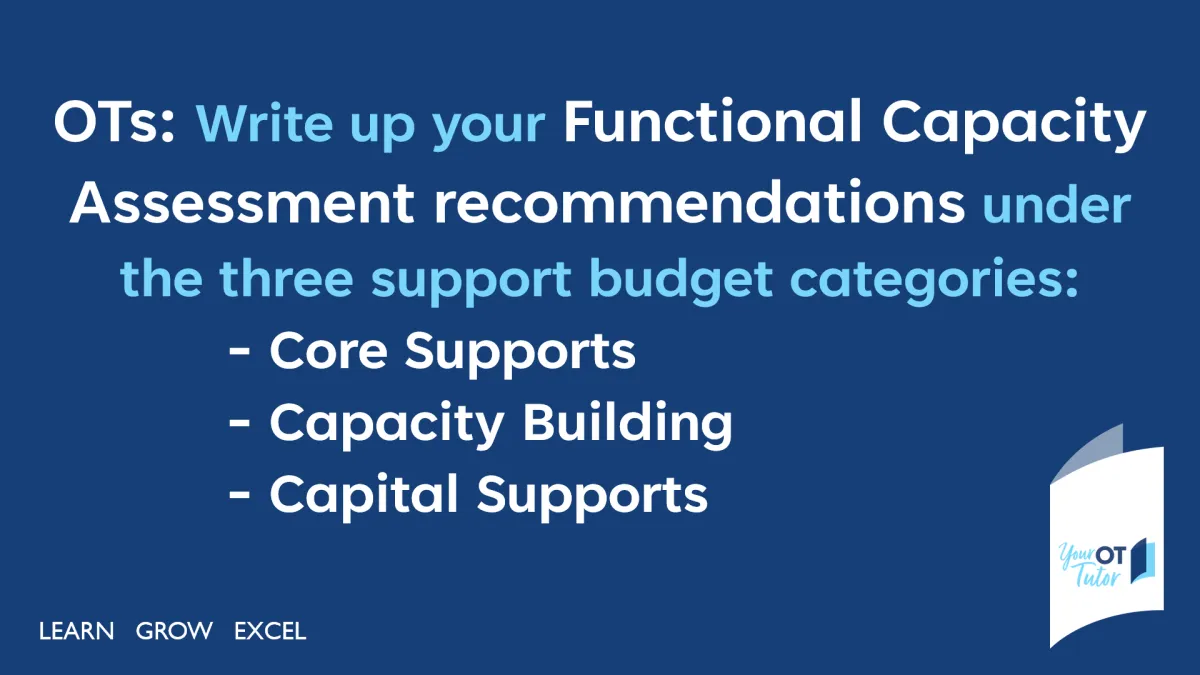
Tip 5: Use the 3 budget categories as sub-headings
Use the three support budget categories as sub-headings when presenting your recommendations so that it is less likely that a recommendation could be overlooked if the list is long; you could also consider presenting the recommendations in a table instead, just make sure the 3 categories are clearly labelled and differentiated.
So what are the three support budget categories, and what type of supports might OTs recommend in each category? The three categories are:
- Core supports budget – for consumables (e.g. continence products), support workers to assist the client with personal or domestic care or community access, and transport funding
- Capacity building budget – for allied health supports (e.g. OT, physio, exercise physiology, speech pathology, psychology and more), positive behaviour support funding or funding for support coordination or psychosocial recovery coaches.
- Capital supports budget – for assistive technology or home modifications (usually those costing more than $1500), or Specialist Disability Accommodation (SDA).
There are no guarantees with anything in the NDIS, however, writing clear recommendations in our reports is one thing we can do as OTs to try to get the funding our clients need to reach their goals.
If you found this blog helpful, keep an eye out for upcoming Your OT Tutor online courses for more tips on how to complete a functional capacity assessment.


Thank you for your interest! Join the mailing list to get notified when new resources are available!
Quick Links
Contact Clare
0413 079 820
yourottutor@outlook.com




© Copyright 2026. Your OT Tutor | All Rights Reserved