THE YOUR OT TUTOR BLOG
Articles on important topics for occupational therapists...
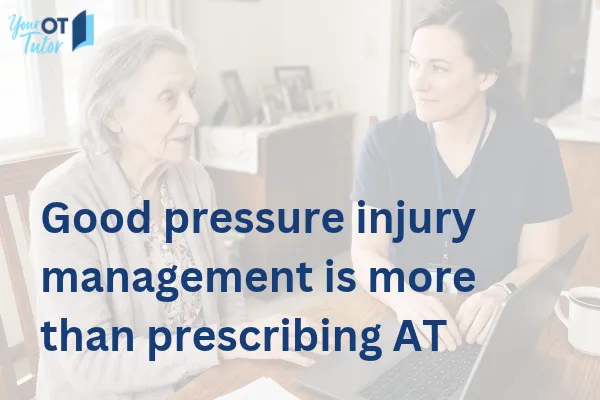
Good pressure injury management is more than prescribing AT
When you’re working in a busy health or disability environment, it’s easy to fall into the autopilot trap when managing pressure injuries. A referral lands on your desk asking for a pressure-relieving cushion or a new mattress, and the temptation is to jump straight into equipment trials, prescribe the equipment, and move on. But is securing funding for a piece of Assistive Technology (AT) really our only goal, or is it establishing a comprehensive, holistic strategy that actively minimises the person's risk of developing a pressure injury?
True clinical competence means looking beyond the instructions provided in the referral. It requires pushing our critical thinking, disrupting those autopilot habits, and tightening our systems to drive better clinical outcomes. While funding is tight and time is limited, we have to protect time for interdisciplinary referrals, genuine client consultation, and systematic outcome measurement.
Here are five common scenarios that show exactly why what the initial referral asks for, shouldn't be where our OT process stops.
1. The hidden nutritional red flag
Imagine you receive a referral for Agatha, an 86-year-old with a grade 1 pressure injury on her sacrum, asking for a cushion and mattress. Your standard process might involve observing her transfers, checking her posture, and completing a standardised screening tool like the Waterlow scale before prescribing the AT.
However, if you look closely at that screening tool, you might spot malnutrition-related risks. By asking a few more questions, you discover she has experienced recent unexplained weight loss and a poor appetite. If we just circle the score and move on, we’ve failed to manage a massive risk factor for wound healing, and there may not be another health professional involved to pick it up either. Pressure injury clinical practice guidelines dedicate an entire section to nutrition, and even if it isn't strictly within our scope to manage directly, we need to act when red flags are raised. Good OT means educating Agatha and her family about how weight loss impacts her risks, communicating this to her GP, and advocating for a dietitian and/or speech pathologist referral.
2. The assumption of functional decline
Next is Brian, a 43-year-old with multiple sclerosis (MS) who needs a new bed because his transfers have become slow and difficult. It’s easy to assume that this deterioration is just a normal part of a progressive condition like MS. We might arrange a bed trial, secure the funding, and tick the box.
But this assumption stops us from being curious. What if we explored when this decline started or whether an acute flare-up or old injury caused it? What is his lower limb sensation and coordination actually like? By working outside our OT silo and involving a physiotherapist for a joint session, we could nut out the pros and cons of transfer equipment together. More importantly, we might uncover reversible changes or implement a maintenance program to preserve his mobility for as long as possible; maintaining his functional capacity rather than just accommodating the decline.
3. The forgotten stakeholder
Consider Cherie, a 62-year-old palliative care client with Stage 4 bowel cancer. The referral asks for a bed and mattress so her adult daughter can care for her at home. We might consult Cherie, pick the best equipment, and show her how to use the bed’s controls.
But what happens when the mattress starts beeping, and the daughter doesn't know what it means? We missed a crucial team member: the carer. Education needs to be multi-modal and collaborative. Instead of just giving a quick demo and leaving a paper handout, we should be treating the daughter as our client too. We need to do hands-on transfer repetitions with the daughter, build in a knowledge check before we leave the session, and provide accessible troubleshooting guides so they know whether to call the OT or the supplier when things go wrong. When the carer is confident, the AT can actually be used to its full potential.
4. The person behind the wound
Daniel is a 51-year-old hospital inpatient with Cerebral Palsy who has been placed on bed rest for a pressure injury. The busy ward environment might make you think if his equipment is sorted by nursing staff, then I can just document to see him when he’s closer to discharge.
But bedrest comes with its own severe risks, including cardiovascular issues, musculoskeletal deterioration, occupational deprivation, anxiety, and depression. Our role doesn't stop just because the wound is being managed by nursing staff. We can review his bed positioning, optimise his environment (even something as simple as ensuring the blinds are open and his whiteboard is updated), introduce simple switch-adapted technology for independence like TV controls, and refer for psychological support. The goal is to ensure there is still a person left once the wound is healed.
5. The missed evaluation
Finally, we have Emily, a 48-year-old with motor neurone disease, referred for ongoing AT prescription as her function declines. We might use tools like the Canadian Occupational Performance Measure (COPM) to keep a functional lens on our goals, prescribe the AT, and check in occasionally. But without formal outcome measurement, how do we actually know if our AT prescription worked?
When we skip formal evaluation, we miss when the prescription is wrong and equipment gets abandoned. We also lose the opportunity to identify gaps in our own learning, meaning we will likely repeat the same mistakes. More importantly, we lose the opportunity to celebrate life-changing wins and gather the data needed to prove the value of allied health to funding bodies like the NDIA. Making time to track, define, and reflect on outcomes builds our clinical confidence and ensures we are delivering genuinely effective care.
My final thoughts...
While it’s easy to write off these extra steps as being too hard in a climate of tight funding and limited time, they are the non-negotiables of best practice. Acknowledging the gap in our processes is the first step to tightening our systems and elevating our practice. Then we work within the resources we have to get as close as possible to best practice as we can, rather than ruling out that best practice isn’t possible without even trying.
I’ve got a few options to help you get started:
Sign-up for one of my CPD membership options – YOTT Connector or YOTT Alliance. These focus on the core skills needed for all OT settings, including following an OT process and working within a multidisciplinary team. It also comes with access to a Journal Club with on-demand sessions on pressure injury management and AT prescription: https://yott.au/membership
Follow the Fast Intelligent Care podcast from Enable Lifecare – Soon I’ll be featured in some episodes talking more about the OT role in pressure injury management, beyond just getting the AT funded! https://enablelifecare.com.au/pages/podcast
Read my blog on tips for measuring outcomes - https://yott.au/blog/b/start-measuring-outcomes
Sign-up for my new course “Measuring outcomes to prove our value” – it goes through goal setting, monitoring progress, and presenting outcome data in an effective way. https://yott.au/measuring_outcomes
Come along to my workshop at the Australian Assistive Technology Conference in Melbourne in November. I’ll be covering practical ways to overcome barriers to AT follow-up: https://aatc2026.com/
Or if you want some 1:1 help, send me a DM and I’ll help you work out where to start.
If you found this blog helpful, check out the Your OT Tutor website and subscribe to the mailing list or sign-up for the Learning Library – there are heaps of resources, courses, and CPD opportunities, with more being added regularly. You can also subscribe to the "How to be a better OT" podcast to hear more from me on your favourite streaming platform. And if you’re ready for something more, the paid YOTT Alliance and YOTT Connector memberships will take you to the next level, so you can be a better OT who loves what you do!
Thank you for your interest! Join the mailing list to get notified when new resources are available!
Quick Links
Contact Clare
0413 079 820
yourottutor@outlook.com




© Copyright 2026. Your OT Tutor | All Rights Reserved